



Japan introduced the Act on the Promotion of Effective Utilization of Resources, which initiated EPR implementation by imposing on manufacturers the adoption of 3Rs (reduce, reuse, recycle). The legislation encouraged producers to voluntarily collect and recycle their products by specifying items for recycling and set recycling targets, along with outlining implementation methods.
The transition from voluntary to compulsory EPR policy came with the Act on the Promotion of Sorted Collection and Recycling of Container and Packaging (Container and Packaging Recycling Act) in 1995. This law, effective two years after its promulgation, required producers of glass bottles and PET bottles, excluding small and medium-sized enterprises (SMEs), to recycle their post-consumer waste. The mandate expanded through an amendment in 2000 to include producers of paper and plastic containers and packaging.
Japan enacted the Basic Act on Establishing a Sound Material-Cycle Society, in the same year, setting the fundamental framework for shifting from a linear society to one promoting resource circulation. The law organises priority for waste disposal methods, emphasising reducing, reusing, recycling, heat recovery, and proper disposal. EPR is underscored as a fundamental principle in waste treatment, highlighting the shared responsibility between the national government, municipalities, businesses, and consumers in achieving the sustainable consumption of resources.
Table 1. Summary of policies, plans, and regulations regarding EPR for containers and packaging in Japan.
Policies, Plans, and Regulations | Promulgation Date | Status |
Act on the Promotion of Effective Utilization of Resources (Act No.48 of 1991) Came into effect in April 2001 | 26 April 1991 | In effect |
Act on the Promotion of Sorted Collection and Recycling of Containers and Packaging (Act No. 112 of 1995) Came into effect in 1997 | 16 June 1995 | In effect |
Basic Act on Establishing a Sound Material-Cycle Society (Act No. 110 of 2000) | 2 June 2000 | In effect |
Obligated Producers
Under the Container and Packaging Recycling Act, businesses that use, manufacture, or import the designated packaging and meet the following conditions are subject to recycling obligations.
Table 2. The scope of businesses subject to EPR obligations in Japan.
Sector | Scope of businesses | |
Annual sales | Number of workers employed regularly | |
Retail, service, wholesale, etc. | More than 70 million JPY | More than 5 |
Manufacturing, incorporated bodies, incorporated foundations, educational foundations, etc. | More than 240 million JPY | More than 20 |
Packaging Items Covered
The EPR policy requires producers to recycle different types of domestic waste, particularly the following materials.

As containers for beverages, cosmetics, etc.,

For general beverages, soy sauce, vinegar, noodle soup, etc., but does not include containers for oil and toiletries,

Which include boxes for washing powder, wrapping paper, paper boards,

Which include bottles and caps for shampoo, plastic bags, plastic caps for pet bottles, etc.
Implementation Mechanism
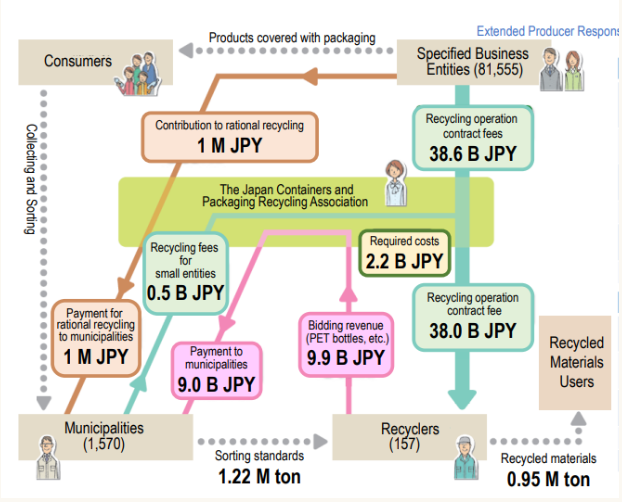
Responsibility sharing among stakeholders across the value chain is one of the prominent features of Japan’s EPR policy. Specifically for containers and packaging, the roles are distributed as follows:
Consumers are responsible for reducing waste discharge and properly sorting waste for disposal
Municipalities are in charge of collecting sorted waste
Businesses are responsible for recycling.
Obligated businesses may fulfil recycling obligations through one of the following three routes.
Self-collection: Directly collecting packaging waste from consumers for recycling, typically used for items such as refillable bottles and polystyrene, often through supermarket collection stations.
Designated organisation: Outsourcing recycling responsibilities to a producer responsibility organisation (PRO) – the Japan Containers and Packaging Recycling Association (JCPRA) – which recycles sorted packaging waste collected by municipalities. Producers are required to pay a recycling commission to recyclers and contributory commission to municipalities through the JCPRA. This is the most commonly used route.
Own recycling: Allows businesses to recycle the collected packaging waste from municipalities either independently or through an organisation other than the PRO, although this route has never been utilised.
Designated business categories using large packaging volumes must report their reduction of packaging waste activities to the national government. If these are deemed insufficient, the government can issue recommendations or directives.
Implementation Timeline
The annual implementation schedule of Japan’s EPR system is outlined in the table below. It should be noted PRO refers to the JCPRA.
Table 3. Implementation timeline of Japan’s EPR scheme for containers and packaging.
Year | Date | Stakeholder | Action |
Previous year (Y-1) | March | Government | Announce recycling amounts and rate of responsibility of designated producers |
July | PRO | Announce call for application for recyclers to register | |
November | PRO | Announce recyclers’ registration examination results and announce call for bidding | |
December | Producers | Start applying for recycling contract to the PRO | |
Current year (Y) | January | Recyclers | Bid for waste storage facilities |
February | Producers | Deadline for recycling contract applications to the PRO | |
March | PRO | Deadline for concluding recycling contracts with producers and recyclers | |
Recyclers | Finish recycling operations from last year’s contract | ||
April | Recyclers | Start recycling operations from this year’s contract | |
July | Producers | Pay recycling fee for recycling operation to the PRO |
Targets
The targeted packaging recycling amount for designated producers is determined based on the Municipal Sorted Collection Plans, which municipalities update every five years. Companies calculate their packaging waste proportion in relation to the total packaging waste collected by the municipality to arrive at their obligatory recycling amount. However, if the recyclers’ recycling capacity is below the amount of collected waste, the obligatory recycling amount is calculated by multiplying the recycling capacity by the company’s packaging waste proportion.
To fulfil these targets, the PRO designates the minimum yield for each recycling method which recyclers must adhere to. Business associations must also set voluntary collection and/or recycling targets for each item.
Incentives and Penalties
Designated producers who fail to fulfil their recycling or packaging waste reduction obligations face penalties as outlined in the table below.
Table 4. Penalties imposed on producers who fail to meet their recycling and reduction obligations.
Offense | Penalty | |
Failure to meet recycling obligations | Failure to meet reduction obligations | |
1st offense | Issuance of a recommendation to fulfill obligations | |
2nd offense | Disclosure of producer’s name | |
3rd offense | Issuance of an order to fulfill obligations | |
4th offense | A fine of less than 1 million JPY | A fine of less than 500,000 JPY |
Table 5. Roles and Responsibilities under Japan’s EPR scheme for containers and packaging
Responsibility | Upstream | Downstream | |
Product Design | Collection | Recycling | |
Physical responsibility | Producer | Government (municipalities) | Recycler |
Financial responsibility | Producer | Government (municipalities) | Producer (via JCPRA) |
Product and financial flows
Updated as of 21 March 2024.
Japan introduced the Act on the Promotion of Effective Utilization of Resources, which initiated EPR implementation by imposing on manufacturers the adoption of 3Rs (reduce, reuse, recycle). The legislation encouraged producers to voluntarily collect and recycle their products by specifying items for recycling and set recycling targets, along with outlining implementation methods.
The transition from voluntary to compulsory EPR policy came with the Act on the Promotion of Sorted Collection and Recycling of Container and Packaging (Container and Packaging Recycling Act) in 1995. This law, effective two years after its promulgation, required producers of glass bottles and PET bottles, excluding small and medium-sized enterprises (SMEs), to recycle their post-consumer waste. The mandate expanded through an amendment in 2000 to include producers of paper and plastic containers and packaging.
Japan enacted the Basic Act on Establishing a Sound Material-Cycle Society, in the same year, setting the fundamental framework for shifting from a linear society to one promoting resource circulation. The law organises priority for waste disposal methods, emphasising reducing, reusing, recycling, heat recovery, and proper disposal. EPR is underscored as a fundamental principle in waste treatment, highlighting the shared responsibility between the national government, municipalities, businesses, and consumers in achieving the sustainable consumption of resources.
Table 1. Summary of policies, plans, and regulations regarding EPR for containers and packaging in Japan.
Policies, Plans, and Regulations | Promulgation Date | Status |
Act on the Promotion of Effective Utilization of Resources (Act No.48 of 1991) Came into effect in April 2001 | 26 April 1991 | In effect |
Act on the Promotion of Sorted Collection and Recycling of Containers and Packaging (Act No. 112 of 1995) Came into effect in 1997 | 16 June 1995 | In effect |
Basic Act on Establishing a Sound Material-Cycle Society (Act No. 110 of 2000) | 2 June 2000 | In effect |
Obligated Producers
Under the Container and Packaging Recycling Act, businesses that use, manufacture, or import the designated packaging and meet the following conditions are subject to recycling obligations.
Table 2. The scope of businesses subject to EPR obligations in Japan.
Sector | Scope of businesses | |
Annual sales | Number of workers employed regularly | |
Retail, service, wholesale, etc. | More than 70 million JPY | More than 5 |
Manufacturing, incorporated bodies, incorporated foundations, educational foundations, etc. | More than 240 million JPY | More than 20 |
Packaging Items Covered
The EPR policy requires producers to recycle different types of domestic waste, particularly the following materials.
As containers for beverages, cosmetics, etc.,
For general beverages, soy sauce, vinegar, noodle soup, etc., but does not include containers for oil and toiletries,
Which include boxes for washing powder, wrapping paper, paper boards,
Which include bottles and caps for shampoo, plastic bags, plastic caps for pet bottles, etc.
Implementation Mechanism
Responsibility sharing among stakeholders across the value chain is one of the prominent features of Japan’s EPR policy. Specifically for containers and packaging, the roles are distributed as follows:
Consumers are responsible for reducing waste discharge and properly sorting waste for disposal
Municipalities are in charge of collecting sorted waste
Businesses are responsible for recycling.
Obligated businesses may fulfil recycling obligations through one of the following three routes.
Self-collection: Directly collecting packaging waste from consumers for recycling, typically used for items such as refillable bottles and polystyrene, often through supermarket collection stations.
Designated organisation: Outsourcing recycling responsibilities to a producer responsibility organisation (PRO) – the Japan Containers and Packaging Recycling Association (JCPRA) – which recycles sorted packaging waste collected by municipalities. Producers are required to pay a recycling commission to recyclers and contributory commission to municipalities through the JCPRA. This is the most commonly used route.
Own recycling: Allows businesses to recycle the collected packaging waste from municipalities either independently or through an organisation other than the PRO, although this route has never been utilised.
Designated business categories using large packaging volumes must report their reduction of packaging waste activities to the national government. If these are deemed insufficient, the government can issue recommendations or directives.
Implementation Timeline
The annual implementation schedule of Japan’s EPR system is outlined in the table below. It should be noted PRO refers to the JCPRA.
Table 3. Implementation timeline of Japan’s EPR scheme for containers and packaging.
Year | Date | Stakeholder | Action |
Previous year (Y-1) | March | Government | Announce recycling amounts and rate of responsibility of designated producers |
July | PRO | Announce call for application for recyclers to register | |
November | PRO | Announce recyclers’ registration examination results and announce call for bidding | |
December | Producers | Start applying for recycling contract to the PRO | |
Current year (Y) | January | Recyclers | Bid for waste storage facilities |
February | Producers | Deadline for recycling contract applications to the PRO | |
March | PRO | Deadline for concluding recycling contracts with producers and recyclers | |
Recyclers | Finish recycling operations from last year’s contract | ||
April | Recyclers | Start recycling operations from this year’s contract | |
July | Producers | Pay recycling fee for recycling operation to the PRO |
Targets
The targeted packaging recycling amount for designated producers is determined based on the Municipal Sorted Collection Plans, which municipalities update every five years. Companies calculate their packaging waste proportion in relation to the total packaging waste collected by the municipality to arrive at their obligatory recycling amount. However, if the recyclers’ recycling capacity is below the amount of collected waste, the obligatory recycling amount is calculated by multiplying the recycling capacity by the company’s packaging waste proportion.
To fulfil these targets, the PRO designates the minimum yield for each recycling method which recyclers must adhere to. Business associations must also set voluntary collection and/or recycling targets for each item.
Incentives and Penalties
Designated producers who fail to fulfil their recycling or packaging waste reduction obligations face penalties as outlined in the table below.
Table 4. Penalties imposed on producers who fail to meet their recycling and reduction obligations.
Offense | Penalty | |
Failure to meet recycling obligations | Failure to meet reduction obligations | |
1st offense | Issuance of a recommendation to fulfill obligations | |
2nd offense | Disclosure of producer’s name | |
3rd offense | Issuance of an order to fulfill obligations | |
4th offense | A fine of less than 1 million JPY | A fine of less than 500,000 JPY |
Table 5. Roles and Responsibilities under Japan’s EPR scheme for containers and packaging
Responsibility | Upstream | Downstream | |
Product Design | Collection | Recycling | |
Physical responsibility | Producer | Government (municipalities) | Recycler |
Financial responsibility | Producer | Government (municipalities) | Producer (via JCPRA) |
Product and financial flows
Updated as of 21 March 2024.




 Indonesia
 Malaysia
 Brunei Darussalam
 Cambodia
 Lao PDR
 Myanmar
 Philippines
 Singapore
 Thailand
 Viet Nam
 China
China
 Republic of Korea
 Japan
Japan